3/06/2007

The 10 Worst Presidents


It's too soon to judge the current one, but for past leaders, the verdict is in
By Jay Tolson
US News & World Report

George W. Bush's presidency shaping up to be one of the worst in U.S. history? You hear the question being asked more and more these days. And more and more, you hear the same answer. With Iraq a shambles and trust in the administration declining, it is probably not surprising that 54 percent of respondents in a recent USA Today/Gallup survey said that history would judge Bush a below-average or poor president, more than twice the number who gave such a rating to any of the five preceding occupants of the White House, including Gerald Ford and Jimmy Carter.

Public opinion is a notoriously fickle beast, of course, which is why historians and other custodians of the long view prefer to reserve judgment until they can speak of their subjects in the past tense. But clearly something about Bush ii has inspired many historians to abandon their usual caution. Meena Bose, a Hofstra University political scientist who has written about presidential ratings, says that the scholars' rush to rank the current president comes out of an acute awareness of the long-term consequences of his policies. "Since it's hard to see how Iraq will work out for the better,'' Bose says, " it's hard not to pass judgments."

Read more about the worst Presidents.

3/05/2007

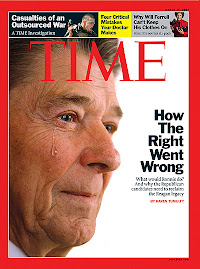
The Republican Road to Perdition


Domenici Called About U.S. Attorney Four Times

At least four recently fired U.S. attorneys who've been issued subpoenas are to testify before the House and Senate judiciary committees Tuesday. The panels are probing allegations that eight federal prosecutors were dismissed by the Justice Department in December for political reasons.

Now a senior Republican senator says he regrets a phone call he made to one of the fired attorneys.

On his last day as U.S. attorney in New Mexico last week, fired federal prosecutor David Iglesias told local reporters that he had been contacted by two congressional Republicans shortly before the November elections.

Iglesias said the two lawmakers, whose names he did not reveal, wanted him to speed up a probe into alleged corruption by a prominent local Democrat.

When the Associated Press asked New Mexico Republican Sen. Pete Domenici, last week about Iglesias' allegations, Domenici was quoted as saying he had no idea what Iglesias was talking about.

But over the weekend, Domenici did an about-face. He issued a statement acknowledging having called the fired U.S. attorney late last year. Domenici said he asked Iglesias about the ongoing investigation and wanted a timeframe on it. He also said that in retrospect, he regretted making the call, and he apologized.

The Justice Department has disclosed that Domenici called U.S. Attorney General Alberto Gonzales four times over the past year and a half to raise questions about Iglesias. A Justice Department spokesman did not respond to repeated requests for further comment.

Domenici's call concerning a case Iglesias was involved has raised ethical concerns. The Senate ethics manual says senators should not communicate with agencies involved in ongoing investigative matters.

What few know about the Patriot Act:

From Law.com

"Recent fallout from the firing of seven U.S. Attorneys revealed that senators last year -- some knowingly and others unknowingly -- waived their advise and consent power by giving the attorney general the sole authority to appoint interim U.S. Attorneys to serve indefinitely when vacancies occurred.

The change in the process came at the request of the U.S. Department of Justice and was inserted into the renewal of the USA Patriot Act that was subsequently adopted by both chambers of Congress. The proverbial "sleeping giant" awakened in the ensuing controversy surrounding the unexplained requests for the resignations of U.S. Attorneys in Arizona, Arkansas, Nevada, New Mexico, San Diego, San Francisco and Seattle."


One more step on toward more Executive Power.
One more step down the road to perdition.


A judge's thoughts on judges and the Constitution

(Note: From time-to-time we get the arm-chair Constitutionalists giving their indoctrinated observations about what the US Constitution is and isn't. My guess, like most of us, their experience with the court system is a traffic ticket, divorce proceedings or some other minor infraction. Nothing that would actually provide any fiber into the intellectual stuffing of their arm-chair conjectures. Such cardboard bantering reminds of the little kids who are all pumped up to see Santa Claus and then clam up when they meet him face-to-face. I found the quote below an interesting observation of a real judge on the workings of the highest court of our land.)

"Justice Douglas, you must remember one thing. At the constitutional level where we work, ninety percent of any decision is emotional. The rational part of us supplies the reasons for supporting our predilections."

Supreme Court Justice Charles Evans Hughes


"I thought of the law in the terms of Moses -- principles chiseled in granite. I knew judges had predilections. I knew that their moods as well as their minds were ingredients of their decisions. But I had never been willing to admit to myself that the 'gut' reaction of a judge at the level of constitutional adjudications, dealing with the vagaries of due process, freedom of speech, and the like, was the main ingredient of his decision. The admission of it destroyed in my mind some of the reverence for the immutable principles. But they were supplied the Constitutions written by people in conventions, not by judges. Judges are, after all, not creative figures; they represent ideological schools of thought that are highly competitive. No judge at the level I speak of was neutral. The Constitution is not neutral. It was designed to take the government off the backs of people, and no wiser man than Hughes ever sat on our (US Supreme) Court. I say that although his predilections, drawn from a different age, were not always mine. I never, for example, could envision (Supreme Court Justice Charles Evans) Hughes in a boxcar filled with Wobblies (IWWs) roaring across the dusty plains of Washington State at night, but it was not difficult to picture Hugo Black, Wiley Rutedge, Felix Frankfurter and Frank Murphy there. I could, however, imagine Hughes as an advocate pleading our cause or as a judge putting imperishable words the tolerance which governments show even the most lowly of us."

William O. Douglas
US Spreme Court Justice (1939-1975)
from The Court Years

3/03/2007

Bush budget cuts veterans health care in 2009


WASHINGTON (AP) -- The Bush administration's budget assumes cuts to veterans' health care two years from now -- even as badly wounded troops returning from Iraq could overwhelm the system.

Bush is using the cuts, critics say, to help fulfill his pledge to balance the budget by 2012. But even administration allies say the numbers are not real and are being used to make the overall budget picture look better.

See CNN Story:

3/01/2007

3/1/1991: "Vietnam Syndrome" declared over!

"By God, we've kicked the Vietnam syndrome once and for all!"

President George H W Bush

President made this statement in a euphoric victory statement at the end of the Gulf War, suggesting the extent to which Vietnam continued to prey on the American psyche more than fifteen years after the fall of Saigon. Indeed the Vietnam War was by far the most convulsive and traumatic of America's three wars in Asia in the 50 years since Pearl Harbor. It set the U.S. economy on a downward spiral. It left America's foreign policy at least temporarily in disarray, discrediting the postwar policy of containment and undermining the consensus that supported it. It divided the American people as no other event since their own Civil War a century earlier. It battered their collective soul.

The summary victory over Iraq was hailed by no less a figure than President Bush as a once-and-for-all elimination of the 'Vietnam syndrome' -- which shows how powerful was the memory of that defeat even 15 years after the fall of Saigon. Addresses three questions (1) why the USA invested so much in contesting communism in Vietnam (2) why its efforts failed -- even today, US explanations tend to assume that it could have been 'done right', overlooking now as then the formidable disadvantages facing US policy (3) the economic and political consequences of the defeat for the USA.

Read more in Foreign Affairs.

02/28/2007: McCain Says U.S. Lives 'Wasted' in Iraq

"Americans are very frustrated, and they have every right to be. We've wasted a lot of our most precious treasure, which is American lives."

John McCain

(Barack Obama recently drew headlines when he described the more than 3,000 Americans killed in Iraq since 2003 as wasted lives. He subsequently apologized.)

Republican presidential contender John McCain, a staunch backer of the Iraq war but critic of how President Bush has waged it, said U.S. lives had been "wasted" in the four-year-old conflict. Democrats demand the Arizona senator apologize for the comment as Sen. Barack Obama did when the Democratic White House hopeful recently made the same observation.


"Americans are very frustrated, and they have every right to be," McCain said Wednesday on CBS'"Late Show With David Letterman.""We've wasted a lot of our most precious treasure, which is American lives."


McCain, who repeated his assertion that U.S. troops must remain in Iraq rather than withdrawing early, made the "wasted" remark after confirming to Letterman what has been clear for at least a year or more — that he's in the running for the 2008 Republican nomination.


"I am announcing that I will be a candidate for president of the United States," he said — and added that he would officially enter the race by giving a formal announcement speech to that effect in April after a visit to Iraq.

Read more...

Like I Didn't See That Coming